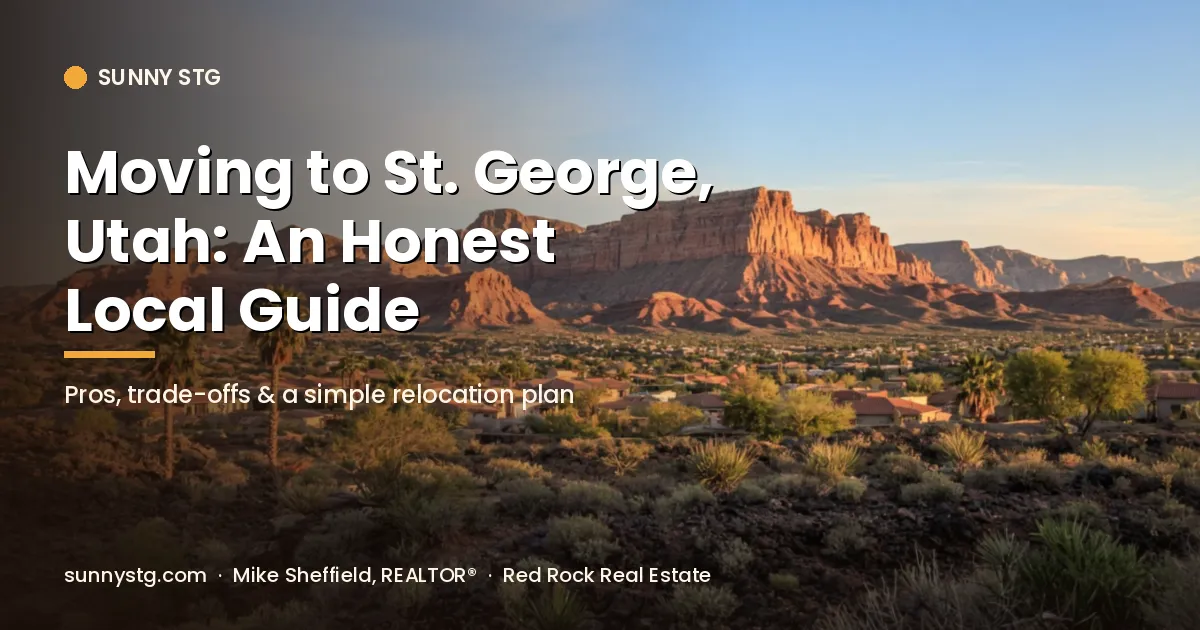
Moving to St. George, Utah: An Honest Local Guide
If you're thinking about moving to St. George, Utah, you're probably weighing the same things everyone does: the red rock scenery, the sunshine, the trails, and whether day-to-day life here actually fits your plans. I'm Mike Sheffield, a local agent with Sunny STG, and I help people relocate to Southern Utah every year. This guide is the honest version I give friends: what people love, what catches newcomers off guard, how the area is laid out, and the practical steps that make a move go smoothly.
Moving to St. George, Utah: The Big Picture
St. George is the hub of Washington County in the far southwest corner of Utah. According to HUD's housing market profile for the area, the St. George metropolitan area covers the same footprint as Washington County, borders Arizona and Nevada, and sits roughly 300 miles south of Salt Lake City and 120 miles northeast of Las Vegas (HUD PD&R Housing Market Profile, data as of August 1, 2025).
That same HUD report estimated the metro population at about 213,700 as of August 1, 2025, and noted that net in-migration accounted for roughly 92 percent of population growth since 2020. In plain English: a lot of your future neighbors moved here from somewhere else, too. That makes it a pretty easy place to land and meet people.
Growth is the thread running through almost everything about life here. It brought new restaurants, medical facilities, retail, and housing options. It also brought construction zones and busier roads. I cover a lot of that growth on this blog, like what's happening at Exit 2 on the south end and in Little Valley.
Pros of Living in St. George
Outdoor recreation right outside your door
This is the number one reason people tell me they're moving. Snow Canyon State Park is on the northwest side of town, and HUD's report places Zion National Park about 40 miles from St. George. Between those, you have city trail systems, mountain biking areas, reservoirs for boating and paddleboarding, and a long list of golf courses.
Hiking and biking on red rock and black lava terrain
Reservoirs like Sand Hollow and Quail Creek for water days
Golf courses spread across St. George, Washington, Hurricane and Ivins
Pickleball, which is a genuine local obsession
Mild winters
Winters here are mild compared with most of Utah and much of the country. Many people spend the cooler months outside more than they ever did where they came from. It's also why St. George has a steady seasonal crowd of snowbirds.
A real city without big-city sprawl
St. George has the services of a regional center, including a hospital system, a university, an airport, and a growing retail and dining scene, while still feeling smaller than a major metro. Most errands are a short drive, and you can be at a trailhead quickly from nearly any neighborhood.
A wide range of housing types
You'll find older established neighborhoods with mature landscaping, golf course communities, newer master-planned areas, townhomes and condos, homes with casitas or RV garages, age-restricted 55+ communities, and larger lots on the edges of the county. Whatever your wish list looks like, there's usually more than one area worth touring.
Cons and Trade-Offs to Plan For
Summer heat is real
Summers are hot. Outdoor life shifts to early mornings, evenings, the pool, or a drive up to higher elevations like Pine Valley. My honest advice: visit in July before you commit. A beautiful February trip doesn't show you the full year. When you tour homes, pay attention to:
The age and service history of the A/C system
Which direction the main windows and backyard face
Covered patios, shade structures, and pool access
Actual summer utility bills from the seller, not annual averages
Housing costs versus local wages
Home prices tend to feel reasonable to people arriving from higher-cost markets and much steeper to people who'll be earning a local paycheck. Rather than quoting a price that will be out of date next month, I'd rather pull current numbers for the specific areas and home types you're considering. Build a full monthly budget: mortgage, property taxes, insurance, HOA dues, utilities, and a repair reserve.
Growth means construction and traffic
New subdivisions, road projects, and commercial centers are going up all over the county. That's great for amenities, but it means you should look at what's planned near any home you're considering. Empty land behind a house today may not stay empty. I'm happy to help you check what's planned around a property before you write an offer.
The job market is narrower than a major metro
HUD's report points to health care and construction as major drivers of local job growth. If you're bringing remote work, a business, or retirement income with you, this matters less. If you'll be job hunting locally, start that search early.
Getting to Know the Area: Towns Around St. George
"St. George" often means the whole Washington County area. Each city has its own layout, amenities and housing mix, and it's worth touring a few before you decide:
St. George: The largest city, with the historic downtown, the most shopping and dining, and neighborhoods that range from established to brand new, including Desert Color on the south end.
Washington: Directly east of St. George, with areas like Washington Fields and the Coral Canyon golf community near the I-15 corridor.
Santa Clara and Ivins: On the west side, closer to Snow Canyon, with Kayenta's art village in Ivins and the newer resort activity covered in my Black Desert Resort update.
Hurricane: East toward Zion, close to Sand Hollow, with a mix of newer subdivisions and larger lots. See my Hurricane Exit 16 update.
Toquerville and Leeds: Smaller communities to the northeast along I-15, with a more rural feel. Here's my look at what's changing in Toquerville and Leeds.
The right area really comes down to your commute, the amenities you want close by, the style of home you like, and your budget. I'll show you any area you're curious about and give you a straight read on the trade-offs.
Taxes and Paperwork New Utah Residents Should Know
The primary residential exemption
Utah offers a property tax break for primary residences. According to the Utah State Tax Commission, qualifying primary residential property gets a 45 percent exemption, so it's taxed on 55 percent of its fair market value. To qualify, the home must be occupied as a primary domicile for at least 183 consecutive days in a calendar year, and only one exemption is allowed per household in Utah (Utah State Tax Commission, accessed October 23, 2026).
Two things to note if you're buying:
Second homes don't qualify. If you're keeping your main home somewhere else and using St. George part of the year, budget for the higher taxable value.
New filing rules start in 2027. The Tax Commission says that beginning January 1, 2027, owners must file Form TC-473A with the county after a change in ownership to receive or keep the exemption, and the deadline is September 15. If you buy a home, put this on your calendar.
Short-term rental rules
If you're hoping to rent your home nightly when you're not using it, check the rules before you buy. St. George city code requires a business license for short-term rentals and a local property manager who's available 24 hours a day (St. George City Code 3-2V-1, accessed October 23, 2026). The city also publishes a list of approved short-term rental areas. Nightly rentals aren't allowed in most standard neighborhoods, so this needs to be part of your search from day one.
A Simple Relocation Game Plan
Visit twice, in different seasons. Ideally once in summer.
Get pre-approved with a lender who knows the local market. It makes your offer stronger and your budget clearer.
Narrow it down to two or three areas. Drive them at rush hour and on a weekend.
Decide on new construction or resale. Builders have their own sales reps. Bringing your own agent means someone is looking out for you.
Read the HOA documents. Rules on RVs, rentals, landscaping and exterior changes vary a lot from one community to the next.
Consider renting first if you're unsure. A few months here can confirm which area really fits.
Plan your move around the heat. Moving furniture in midsummer is no fun. Spring and fall are much easier.
Frequently Asked Questions About Moving to St. George
Is St. George, Utah a good place to live?
For many people, yes, especially if you love the outdoors, mild winters and a mid-sized city feel. The trade-offs are summer heat, ongoing construction from growth, and a narrower local job market than a big metro. Visiting in summer is the best way to know for sure.
How far is St. George from Las Vegas and Salt Lake City?
HUD's housing market profile places the St. George area about 120 miles northeast of Las Vegas and roughly 300 miles south of Salt Lake City. Many residents use Las Vegas or the St. George Regional Airport for travel.
Which town near St. George should I move to?
It depends on what you want close by. St. George has the most shopping and services, the west side (Santa Clara and Ivins) is close to Snow Canyon, Washington and Hurricane offer quick access toward Zion and the reservoirs, and Toquerville and Leeds feel more rural. Touring a few is the best way to decide.
Do I pay less property tax if St. George is my primary home?
Generally, yes. Per the Utah State Tax Commission, qualifying primary residences are taxed on 55 percent of market value. Second homes don't qualify, and new owners will need to file Form TC-473A starting in 2027.
Can I buy a home in St. George and rent it out nightly?
Only in approved areas, and only with a city business license and a local property manager. Check the city's approved short-term rental list and the HOA rules before you make an offer.
Thinking About Moving to St. George? Let's Talk
Relocating is a big decision, and a little local insight can save you a lot of time. I'm happy to set up a call, put together a tour of a few areas, or just answer questions while you're still deciding. No pressure. Reach out through my contact page, book a time to chat, or call (435) 222-3080.
Mike Sheffield, REALTOR® with Red Rock Real Estate | Sunny STG
